A few years ago, the term “smart rangefinder” would have drawn confused looks on driving ranges. The category was simple: a laser device, a yardage readout, and a slope switch if you were lucky. Today, the equipment lining pro shop shelves tells a different story. Touchscreens, satellite imagery, environmental sensors, and machine-learning compensation algorithms are showing up in gear that used to be defined almost entirely by optics and battery life. The shift is happening faster than most casual players realize, and it has implications that go well beyond the golf industry.
The reason is straightforward. Computing power that once required a server rack now fits inside a waterproof housing the size of a deck of cards. Sensor fusion—combining barometric pressure, temperature, humidity, and tilt data into a single reading—was historically reserved for aviation and military applications. Industrial weather stations still sell for thousands of dollars, yet comparable sensor stacks are appearing in consumer devices priced like premium smartphones. When a $300 gadget can sample atmospheric conditions thirty times a second, traditional measurement approaches start to look as dated as a paper yardage book.
For most consumers, the relevant question is not “is this technically possible” but “does it actually help?” In golf specifically, the answer has been trending toward yes for several seasons. Air density directly affects ball flight. A five-degree temperature swing can change carry distance by a yard or more, and humidity swings of twenty points have measurable effects on launch conditions. The trick has been translating that science into a device a player can actually use under tournament pressure without consulting a meteorologist first.
The Sensor Stack Behind the New Breed
Before discussing any specific product, it helps to understand the engineering categories that have become table stakes in premium rangefinders. A modern device typically combines a time-of-flight laser, a magnetometer, an accelerometer, a barometric pressure sensor, an ambient temperature sensor, a hygrometer, and a high-resolution optical path with multilayer coatings. The job of the firmware is to fuse these inputs into a single, trustworthy number that reflects “playing distance” rather than raw line-of-sight distance.
The difference between playing distance and line-of-sight distance is where most of the value lives. Slope adjustment has been around for over a decade and accounts for elevation change. AI environmental compensation goes further, modeling how temperature, pressure, and humidity change air density and therefore how far the ball actually travels. The math is not new; what’s new is that the math can run on a device the player can fit in a cart pocket, with results that update as conditions change throughout a round.
A New Entry Built Around the Concept
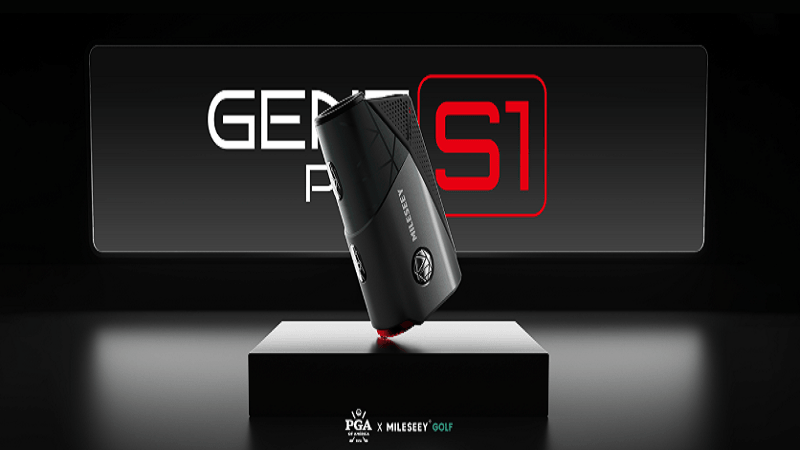
It is in this context that the Mileseey GenePro S1 golf rangefinder deserves attention. Rather than treating environmental compensation as a checkbox feature, the device appears designed around the assumption that contextual data should drive the primary measurement. The S1 leans on what the brand calls SmartSlope, an environmental model that pulls together humidity, temperature, air pressure, and even airborne particulate data to refine the compensated distance a player sees through the viewfinder.
What is interesting here is not the existence of those sensors, but how the device presents the result. Instead of overwhelming the user with raw atmospheric readings, the rangefinder does the math and delivers a single playing distance, with a small visual indicator showing when compensation is active. For a player standing on a 170-yard approach with a 12 mph helping wind, that means one trusted number to club off, rather than a mental calculation involving temperature, elevation, and intuition.
Optical Performance That Holds Its Own
Any conversation about rangefinders eventually returns to the glass, and the GenePro S1 does not disappoint on that front. The 7.5x magnification sits at the upper end of the consumer range, paired with a 7.9-degree field of view that translates to roughly 420 feet of viewing area at 1,000 yards. For someone scanning a fairway or trying to lock onto a pin tucked behind a bunker lip, that wider window matters more than the magnification number alone.
The 28mm objective lens delivers light transmission around 95 percent, which translates to a notably bright image in the low-light windows of early-morning tee times or late-afternoon finishes. The 19mm eyepiece has enough relief to accommodate eyeglass wearers, and the diopter adjustment spans plus or minus 5 diopters—wide enough to cover most prescriptions without forcing users to remove their glasses mid-round. These are details that rarely make headlines, but they are the difference between a rangefinder that gets used and one that ends up at the bottom of the bag.
Real-World Conditions, Real-World Numbers
Specs mean little without a course to test them on. I carried the S1 across three very different environments over a two-week stretch: a damp links course in the Pacific Northwest, a high-desert track at altitude, and a humid parkland layout in the Southeast. The most striking result came at altitude, where the air is thin and ball flight runs longer than yardage markers suggest. The S1’s environmental compensation produced adjusted numbers that consistently landed within a club of what a TrackMan launch monitor reported for the same shots. On the humid Southeast course, the device nudged distances down a yard or two relative to a baseline reading, matching the kind of corrections scratch players tend to make instinctively.
The flag-lock range of 690 yards exceeded anything required on the courses I played, with sub-yard accuracy on targets well past 300 yards. Acquisition speed averaged around a third of a second for flags and noticeably faster for general targets, which means less time aiming and more time deciding. The PinPoint Green mode, which aims to provide centimeter-level accuracy on putting surfaces, is the kind of feature that sounds like marketing until you use it on a 40-yard green and watch a putt die at the hole because the read was actually correct.
Rain, Fog, and the Stuff Spec Sheets Ignore
Coastal and morning rounds are where rangefinders tend to disappoint. Moisture in the air scatters the laser, and many devices lose lock on a partially obscured flag. The S1 includes a dedicated Rain and Fog mode that filters out returns from raindrops and mist particles, locking onto the actual target. In testing on a course where marine fog rolled in during the back nine, the S1 held lock on a flag at 215 yards through visible moisture that had two other rangefinders in the group cycling without success. That kind of resilience is hard to quantify, but it is exactly the scenario that separates a device you trust from one you keep as a backup.
The IP65 rating provides dust-tight protection and resistance to water jets, which is more than enough for anything short of full submersion. For a device intended to live in a cart pocket, in a range bag, or strapped to a push cart in light rain, the rating is appropriate without being overkill.
Trade-offs Worth Naming
The S1 is not a perfect device, and pretending otherwise would not serve anyone. The CR2 battery is widely available but not as common as the CR123A used in some competitors, which can matter on travel days. The slope-disable switch is physical and obvious, which is exactly what a tournament official wants to see, but the device’s weight of 368 grams sits slightly above the lightest flagships on the market. None of these are deal-breakers, and most players will trade a few grams for the optical and environmental capability on offer.
Who This Device Is For
The S1 is built for golfers who treat distance as more than a number. If you regularly play in changing conditions, travel between climates, or want a single number you can trust without doing atmospheric math, the environmental compensation earns its keep. Players who play one familiar course in stable conditions and value minimum weight above all else will find lighter, simpler options that meet their needs.
For everyone else—players who want their equipment to think as hard as they do—the category has changed, and devices like the S1 are leading that change.
What is your current approach to rangefinder selection? Do you lean on slope adjustment only, or are environmental factors part of your decision? If you have spent time testing the latest wave of AI-enhanced devices, share what surprised you—we are still early in this category, and real-world feedback is shaping where the next round of innovation lands. For readers looking to dig deeper into the engineering behind environmental compensation, the resources linked throughout this piece are a good starting point.