
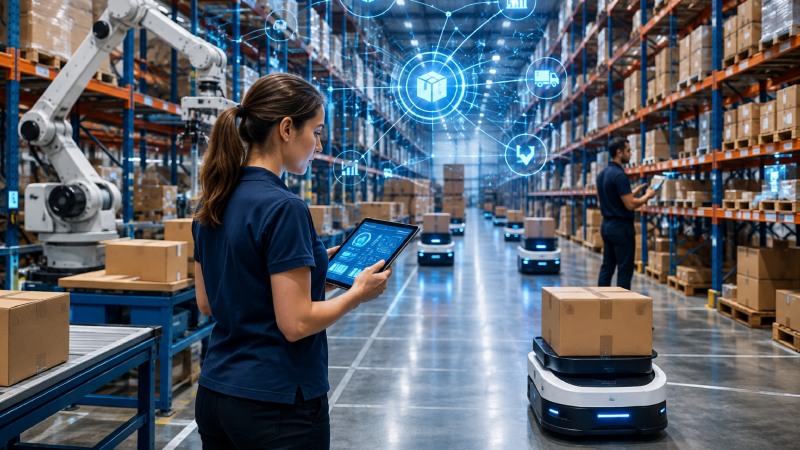
Warehouses are becoming increasingly data-driven environments. Every incoming shipment, inventory movement, stock adjustment, and outgoing order generates information that can improve operations. The challenge for warehouse teams is processing that information quickly enough to make better decisions while keeping daily workflows efficient.
Artificial intelligence and automation are changing that. Combined with AI-powered warehouse management, these technologies can reduce repetitive work, improve inventory visibility, identify operational patterns, and help warehouse teams respond to changing demand. The result is a warehouse management model that is becoming smarter and more proactive.
Automation handles repetitive warehouse processes, while AI helps teams understand the data those processes generate.
AI and Automation Play Different Roles
Although AI and automation are often discussed together, they solve different warehouse management challenges.
Automation focuses primarily on completing predefined tasks with less manual intervention. A warehouse management system might automatically update inventory after an item is received, record a stock transfer, or generate an operational report.
AI goes further by analyzing information and identifying patterns that can support decision-making.
For example, automation can update stock quantities after inventory moves. AI can analyze historical stock movements to identify demand patterns that may influence future replenishment.
Together, they create a more intelligent approach to warehouse management.
| Warehouse Automation | AI-Powered Management |
| Executes predefined workflows | Analyzes operational patterns |
| Automates inventory updates | Supports demand forecasting |
| Reduces repetitive data entry | Identifies unusual activity |
| Standardizes processes | Provides decision support |
| Generates operational data | Extracts insights from data |
Automation Reduces Repetitive Warehouse Work
Warehouse operations contain numerous tasks that must be performed repeatedly and accurately.
Receiving teams record incoming inventory. Employees update stock locations. Inventory movements must be documented, and managers need regular reports about warehouse activity.
Handling these processes manually can consume valuable employee time while increasing opportunities for data-entry errors.
Automation allows warehouse management software to digitize routine workflows, including:
- Inventory receiving
- Stock updates
- Internal inventory transfers
- Replenishment records
- Order processing
- Operational reporting
Reducing administrative work allows warehouse employees to spend more time on physical operations, quality control, and exception management.
AI Makes Inventory Planning More Predictive
Inventory management traditionally relies heavily on historical reports and fixed replenishment rules. While these approaches remain useful, they may not always capture rapidly changing demand.
AI can analyze larger amounts of inventory data to identify patterns that might otherwise be difficult to recognize.
Changes in product movement, recurring seasonal demand, and unusual increases or decreases in inventory activity can provide useful signals for warehouse managers.
These insights can help teams determine when stock may need replenishment or when inventory levels should be reviewed.
The shift toward AI-powered warehouse management is a shift from asking what happened to asking what may happen next.
This does not mean AI should make every inventory decision automatically. Experienced warehouse managers still need to consider supplier constraints, business priorities, and unexpected events. AI provides additional information that can make those decisions more informed.
Smarter Slotting Can Improve Warehouse Efficiency
Inventory location has a direct impact on productivity.
If frequently picked products are stored in inconvenient locations, employees may spend unnecessary time traveling through the warehouse. Across thousands of picks, small inefficiencies can become significant.
AI can analyze inventory movement and picking patterns to help identify opportunities for better product placement.
Fast-moving inventory might be positioned closer to packing or dispatch areas, while slower-moving stock can occupy less accessible locations.
Smarter slotting improves warehouse efficiency by reducing unnecessary movement rather than requiring employees to simply work faster.
AI Can Help Identify Operational Bottlenecks
Not every warehouse bottleneck is immediately obvious.
A receiving process might gradually become slower as volumes increase. Certain products may repeatedly create picking delays. Inventory discrepancies might occur more frequently within a particular workflow.
AI can analyze operational data across thousands of transactions and highlight patterns that deserve attention.
Managers can then investigate the underlying cause and determine whether changes to processes, inventory placement, staffing, or training are required.
This makes warehouse management more proactive. Teams gain an opportunity to address recurring inefficiencies before they become larger operational problems.
Automation Strengthens Inventory Visibility
Accurate inventory information is essential for warehouse management.
When stock movements depend on employees manually updating spreadsheets or separate systems, records can quickly become outdated. This creates uncertainty about what inventory is available and where it is located.
Automated digital workflows allow inventory records to be updated closer to the point where movements occur.
Better visibility helps warehouse teams:
- Locate inventory faster
- Monitor stock availability
- Reduce discrepancies
- Improve replenishment decisions
- Respond to fulfillment requirements
AI becomes considerably more useful when it has reliable information to analyze, making accurate digital inventory records an important foundation for intelligent warehouse operations.
People Remain Essential to Warehouse Intelligence
AI and automation do not eliminate the need for skilled warehouse professionals.
Technology can identify a pattern, but people still need to understand its operational context. An unusual inventory movement could indicate changing customer demand, a supplier issue, an internal process problem, or simply a one-time event.
Warehouse managers bring the judgment required to interpret these situations.
The most effective model therefore combines automation for predictable tasks, AI for analysis, and human expertise for decisions requiring experience and context.
Building the Intelligent Warehouse
AI and automation are moving warehouse management beyond basic inventory tracking.
Automation reduces repetitive work and creates more consistent digital processes. AI uses the resulting data to identify patterns, support forecasting, and reveal opportunities for operational improvement.
Together, these technologies can help businesses improve inventory visibility, optimize warehouse resources, and respond more effectively to changing demand.
The future of warehouse management is not simply a facility filled with more automation. It is an operation where technology and human expertise work together, using better data to make smarter decisions about inventory, workflows, and the resources required to keep goods moving efficiently.