
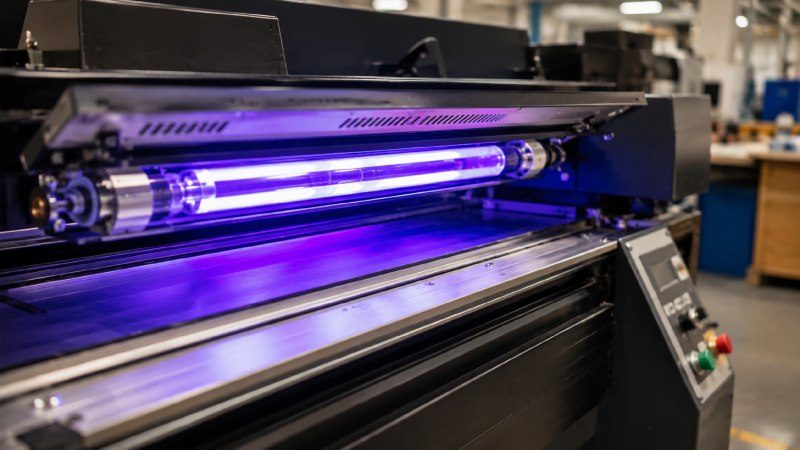
A UV curing system can be dialed in perfectly — right speed, right power settings, right conveyor configuration — and still underperform if the bulb inside it isn’t up to spec. It’s easy to overlook a component this small when troubleshooting a curing problem, but it’s often exactly where the issue starts.
Why UV Curing Depends So Heavily on Bulb Quality
UV curing relies on precise wavelength output and consistent intensity to properly cure inks, coatings, and adhesives at production speed. A bulb that’s degraded, mismatched, or manufactured with looser tolerances can lead to incomplete curing, which shows up downstream as tacky surfaces, poor adhesion, or inconsistent finish quality. Because curing happens in fractions of a second as material passes under the lamp, there’s very little margin for a bulb that isn’t performing at full spec — problems that would be minor in a slower process become production-stopping issues at typical line speeds.
What Determines Replacement Bulb Compatibility
Replacement bulbs for UV curing systems need to match several specifications to perform correctly within a given unit: arc length, wattage, doped element composition (which determines the specific wavelength output), and physical dimensions all need to align with what the system was originally designed to run. A bulb that’s close on paper but slightly off on one of these specs can still fit physically while underperforming functionally, which is why sourcing from a supplier who understands these technical details matters more than simply matching a part number.
How Bulb Degradation Affects Output Over Time
UV bulbs don’t fail suddenly in most cases — they degrade gradually, losing intensity over hundreds or thousands of operating hours even while still producing visible light. This gradual decline can be deceptive, since a bulb might look and function normally while actually curing at a fraction of its original output. Production issues that seem to appear out of nowhere — inconsistent cure quality on a line that was running fine for months — often trace back to this kind of slow degradation rather than any recent change in process settings.
Signs a Bulb Needs Replacement
A few indicators tend to show up before a bulb fails outright: inconsistent curing across a batch that previously ran uniformly, a visible dimming or color shift in the bulb’s output, increased scrap rates without any corresponding process change, or a bulb that’s simply logged more operating hours than its rated lifespan. Tracking bulb hours as part of routine maintenance, rather than waiting for a visible problem, tends to catch degradation before it affects a full production run.
Choosing Between OEM and Compatible Replacement Options
Businesses running UV curing equipment generally have a choice between original manufacturer bulbs and compatible replacement options built to the same specifications. Compatible replacements, when properly matched to the original system’s requirements, can offer meaningful cost savings without sacrificing performance, provided the supplier has verified compatibility across all the relevant technical specs. The key differentiator isn’t the source of the bulb — it’s whether the replacement genuinely matches arc length, wattage, and doping specifications closely enough to perform as intended.
Matching a Bulb to a GEW System Specifically
Different UV curing manufacturers build systems around specific bulb configurations, and GEW UV lamp replacements need to match the exact specifications of the housing unit they’re going into — arc length and wattage in particular tend to vary across different GEW model lines. Getting this match right avoids both performance shortfalls and potential compatibility issues with the housing itself, since a bulb that doesn’t seat or align correctly can create uneven curing across the width of a web or substrate.
Why Supplier Expertise Matters for Industrial Lamps
Sourcing specialty lamps isn’t the same as ordering a generic commodity part. A supplier familiar with the technical requirements across wood finishing, plastic forming, label and packaging printing, and adhesive assembly applications can help identify the right replacement specifications rather than leaving a buyer to guess based on part numbers alone. This kind of expertise becomes especially valuable when a system is older or when documentation on original specifications has been lost over the years.
Extending Bulb Life With Proper Maintenance
A few maintenance habits can meaningfully extend how long a bulb performs at full output. Keeping reflectors and housings clean prevents contamination that can affect both cooling and light distribution. Following manufacturer-recommended warm-up and cool-down cycles reduces thermal stress that accelerates degradation. Monitoring operating hours and scheduling replacement proactively, rather than reactively after a quality issue appears, keeps production consistent and avoids the scrap costs associated with running on a degraded bulb longer than intended.
Planning Replacement Before It Becomes an Emergency
Unplanned downtime tends to cost far more than the price of the bulb itself, especially on production lines running tight schedules or contracted delivery windows. Keeping a spare on hand for critical systems, rather than ordering only after a failure occurs, avoids the scramble of expedited shipping and the production gap that comes with waiting for a replacement to arrive. This is particularly important for less common configurations, where lead times can run longer than for standard, widely stocked options. Building bulb replacement into a regular maintenance schedule — rather than treating it purely as a reactive repair — tends to be the more cost-effective approach over the long run.
Conclusion
A UV curing system’s performance ultimately comes down to whether the bulb inside it is genuinely matched to the system’s specifications and still operating within its effective lifespan. Sourcing replacements from a supplier who understands these technical requirements helps keep production running smoothly rather than troubleshooting quality issues after the fact.