
At age three, a child’s world expands dramatically beyond the immediate family unit. The early toddler years of playing side-by-side without much direct interaction give way to an exciting phase of interactive friendships, emotional discovery, and burgeoning independence.
Understanding these developmental markers helps parents and caregivers celebrate genuine progress, identify areas where a child might need gentle encouragement, and foster strong self-assurance. Here are five foundational social milestones most three-year-olds reach as they navigate relationships with peers and adults.
1. Shifting from Parallel Play to Joining Peers
Quick Answer: Around age three, children transition from playing next to peers (parallel play) to actively noticing other kids and inviting themselves into shared activities (cooperative play).
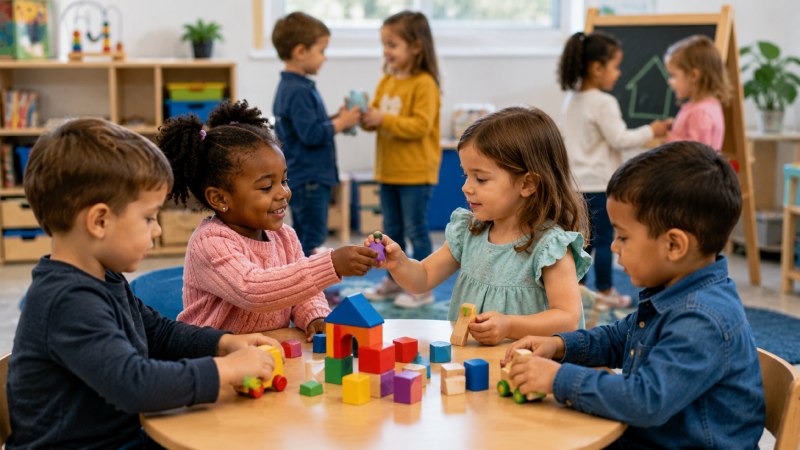
During infancy and early toddlerhood, children engage primarily in parallel play—sitting near another child building blocks without interacting directly. By age three, social awareness blossoms. A child begins to observe what peers are doing, make eye contact, and initiate simple interactions like handing a toy car to a playmate or joining a sandbox castle-building effort.
This shift marks the beginning of true peer interaction. While three-year-olds still experience moments of solitary play, their growing curiosity draws them toward collaborative activities, laying the foundation for early friendships and shared experiences.
2. Calming Down After Separation from Primary Caregivers
Quick Answer: A three-year-old should be able to settle down within 5 to 10 minutes after a parent or caregiver leaves at drop-off, relying on predictable routines and comforting adults.
Separation anxiety is completely natural, but by age three, children develop the emotional resilience needed to recover from goodbyes relatively quickly. While tears at drop-off can still happen—especially during routine changes or after long weekends—a three-year-old typically calms down within ten minutes once distracted by an engaging activity or supported by a trusted teacher.
Enrolling your child in a supportive environment, such as a quality day care in Salt Lake City, provides a structured setting to practice these daily transitions. Predictable drop-off routines, reassuring goodbye phrases, and familiar caregiving staff help young children build emotional security and trust when away from home.
3. Naming Basic Emotions and Showing Early Empathy
Quick Answer: Three-year-olds begin identifying core emotions like “happy,” “sad,” or “mad” in themselves and others, often offering simple comfort when a peer is upset.
Emotional literacy develops rapidly during the preschool years. Three-year-olds begin to connect physical sensations and feelings with verbal labels, articulating when they feel sad, excited, or frustrated instead of relying solely on tantrums.
Alongside personal emotion labeling, early empathy emerges. When a classmate cries after a fall, an empathetic three-year-old might pat their back, offer a favorite blanket, or alert a teacher. Tracking 3-year-old emotional development milestones allows parents to celebrate these heartwarming glimpses of compassion and emotional intelligence.
4. Understanding Turn-Taking and Basic Sharing
Quick Answer: Three-year-olds start understanding the concept of “mine” versus “yours,” allowing them to wait brief periods for a turn with guidance from adults.
Sharing is notoriously difficult for toddlers, but three-year-olds are beginning to grasp social equity. They recognize that toys belong to the group or another individual and can wait short intervals—such as taking turns on a slide or trading crayons—when supported by simple visual or verbal cues.
- Use Visual Timers: A sand timer helps young children visualize when a turn is ending without feeling like a toy is being permanently taken away.
- Practice Turn-Taking Games: Simple board games or turn-taking activities teach children how to wait for their turn in a fun, low-stakes setting.
- Model Cooperative Play: Utilizing effective cooperative play strategies for preschoolers helps children replace snatching behaviors with polite verbal requests like “My turn next?”
5. Engaging in Imaginative Pretend Play with Others
Quick Answer: Three-year-olds use creative imagination to act out shared scenarios with peers, such as playing house, cooking in a play kitchen, or pretending to be animals.
Imaginative play reaches an exciting evolution at age three. Rather than playing doctor or firefighter alone, three-year-olds invite peers into their pretend worlds. One child cooks play-dough “pizza” while another acts as the customer, assigning roles and following loose storylines.
This cooperative pretend play requires communication, negotiation, and flexibility. Through shared fantasy play, children experiment with social roles, practice active listening, and build creative problem-solving skills alongside their playmates.
6. How Parents Can Support Social Skill Development
Supporting early social growth does not require elaborate lesson plans; daily interactions offer the best teaching moments.
- Label Feelings Daily: Use emotion words during storybooks and daily conversations (e.g., “The bunny looks worried because he lost his hat”).
- Arrange Small Playdates: Host short, 60-to-90-minute playdates with one or two peers to practice sharing in an uncrowded setting.
- Encourage Problem-Solving: When minor disputes happen, guide children to brainstorm solutions together rather than immediately stepping in to resolve the issue for them.
Focusing on intentional early childhood social skill building at home accelerates a child’s confidence when navigating larger group settings like preschool or community playgrounds.
Myth vs. Fact: 3-Year-Old Social Development
- Myth: A three-year-old should share all their toys without throwing a fit.
- Fact: Sharing is a complex skill that takes years to master. Occasional reluctance to share a prized possession is completely normal at this age.
- Myth: Shy three-year-olds are behind socially.
- Fact: Temperament varies widely. A child who prefers observing before joining in is simply processing their environment at their own comfortable pace.
- Myth: Tantrums completely disappear by age three.
- Fact: While tantrums decrease as verbal skills improve, fatigue, hunger, and sensory overload can still trigger emotional meltdowns in three-year-olds.
Every child develops on their own unique timeline, and social growth happens in gradual waves rather than overnight leaps. Celebrating small victories—like a smooth drop-off goodbye, a shared box of crayons, or a comforting hug offered to a friend—builds a strong foundation for lifelong social-emotional health. By providing gentle guidance, predictable routines, and ample opportunities for peer play, you give your three-year-old the tools and confidence they need to thrive in a social world.