
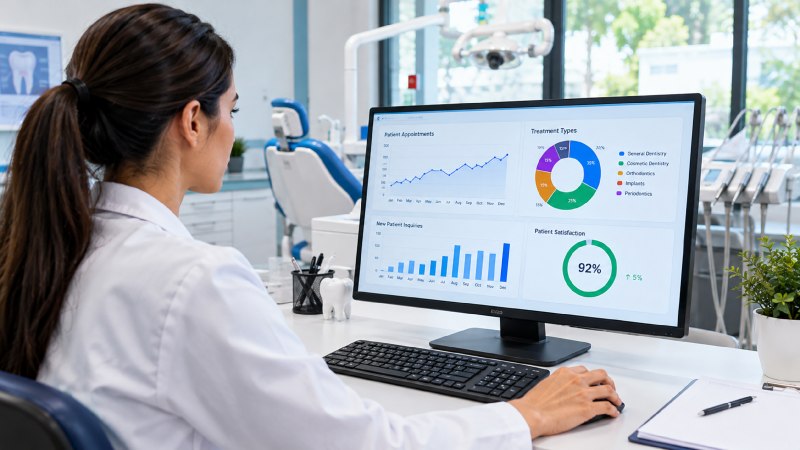
Growth in dentistry has traditionally been associated with familiar measures of success: a fuller appointment book, additional treatment rooms, modern equipment and a growing list of patients. Yet the business environment surrounding Australian dental practices is becoming more complex. Patients research treatments online, compare providers, expect transparent communication and increasingly interact with digital systems before they ever sit in a dental chair.
In this changing landscape, sustainable growth requires more than clinical excellence alone. It demands an understanding of how patients make decisions, how resources are used and where a practice can improve its services without compromising care. Data-driven decision-making offers a way to connect these elements, transforming business strategy from a series of assumptions into a more informed process of continuous improvement.
Beyond Intuition: Understanding the Modern Dental Business
Experience remains valuable in dentistry, but experience becomes more powerful when supported by reliable information. A practice owner might believe that a particular treatment is driving growth, for example, only to discover that most new patient enquiries originate from preventive services or referrals.
Analysing appointment records, enquiry sources, cancellation rates and treatment acceptance can reveal patterns that are otherwise difficult to recognise. These insights allow practice owners to ask better questions: Which services are patients actively seeking? Where do prospective patients abandon the booking process? Are appointment schedules being used efficiently? Which communication methods help patients understand their treatment options?
For an individual dentist, this information can improve the relationship between clinical priorities and operational planning. For a practice manager or business owner, it can guide staffing decisions, appointment availability and investment in new technology.
The objective is not to reduce healthcare to a collection of numbers. Rather, it is to use evidence to understand where a practice can serve people more effectively.
Australia’s Oral Care Market and the Opportunity for Smarter Growth
Australia’s dental sector operates within a substantial healthcare economy, supported by demand for preventive examinations, restorative procedures, orthodontics, cosmetic treatments and ongoing periodontal care. An ageing population, greater awareness of oral health and advances in digital dentistry all contribute to evolving patient needs.
For business owners, the important question is not simply how large the industry may become. It is how individual practices can respond to changing demand while remaining financially sustainable and clinically responsible.
Data can help identify underserved patient groups, evaluate demand for particular services and assess whether proposed investments align with local needs. A practice in a growing suburban community, for instance, may benefit from understanding family appointment patterns, while another may find greater demand for restorative care among older patients.
Data offers a practical foundation for that evolution. It can help a dentist identify opportunities, improve patient communication, strengthen financial decisions and build a more resilient practice.
Market opportunity becomes meaningful when it informs decisions that are appropriate for the community being served.
Turning Patient Data into Better Business Decisions
Dental practices generate information through bookings, clinical records, billing systems, patient feedback and digital enquiries. When collected and interpreted responsibly, these sources can provide a clearer picture of practice performance.
Consider appointment cancellations. A high cancellation rate may initially appear to be a scheduling problem, but further analysis could reveal that patients are receiving reminders too late, finding appointment times inconvenient or struggling to understand treatment costs.
Each explanation suggests a different response. Automated reminders may reduce missed appointments, while clearer financial information or more flexible scheduling could address other barriers.
Similarly, analysing the journey from website visit to consultation can help identify weaknesses in patient communication. If many people enquire about a service but few book an appointment, the issue might involve unclear pricing information, a complicated booking form or insufficient explanation of the consultation process.
These insights support targeted improvements rather than expensive, broad changes based on guesswork.
However, patient information must be handled carefully. Australian privacy obligations, appropriate access controls and secure information systems are essential when collecting or analysing health-related data. Practices should use information for legitimate purposes, protect confidentiality and avoid collecting unnecessary details.
Digital Marketing Meets Measurable Performance
A strong online presence can help dental practices reach people who are already looking for care. Yet website traffic alone does not necessarily translate into meaningful business growth.
A more sophisticated approach evaluates how marketing contributes to relevant enquiries, consultations and long-term patient relationships. Search engine optimisation, educational articles, local search visibility and paid advertising can each play a role, but their effectiveness should be assessed against clear objectives.
For example, a practice investing in local search optimisation might monitor whether its service pages attract relevant visitors, whether those visitors make enquiries and whether the resulting appointments are appropriate for the practice’s capabilities.
This allows marketing budgets to be allocated more intelligently. Rather than continually investing in the channel with the most clicks, owners can assess which activities generate genuine interest and support sustainable patient acquisition.
Content also has an important role. Articles explaining dental implants, gum disease or preventive examinations can help patients understand their options before speaking with a clinician. When information is accurate, accessible and free from exaggerated claims, it supports both informed decisions and a stronger professional reputation.
In Australian dentistry, marketing must also comply with applicable advertising requirements, including Australian Health Practitioner Regulation Agency (Ahpra) rules where relevant. Performance should never be improved at the expense of truthful communication or patient welfare.
Financial Intelligence Without Losing the Human Element
Data-driven strategy can also strengthen financial planning. Understanding treatment costs, staff utilisation, laboratory expenses and equipment investment helps owners assess profitability and anticipate financial pressure.
A practice considering a new digital scanner, for instance, should evaluate more than the equipment’s purchase price. Relevant considerations include training, maintenance, integration with existing systems, potential workflow improvements and whether the technology addresses a genuine patient or clinical need.
Likewise, revenue growth should not be confused with overall business health. Increasing appointment numbers may create additional workload without improving margins if staffing, materials and administrative costs rise disproportionately.
Useful financial measures must therefore be interpreted alongside patient outcomes, service quality and staff capacity. The most sustainable business model is one that supports efficient operations while preserving enough time and resources for attentive clinical care.
Preparing for the Next Era of Dental Innovation
Artificial intelligence, digital imaging, automated administration and integrated practice-management platforms are changing how healthcare businesses operate. In dentistry, these tools may support image analysis, streamline documentation and reveal operational patterns that would otherwise remain hidden.
The statement that oral care is becoming a billion-dollar industry in Australia reflects the scale of the commercial opportunity, although the precise size and growth rate depend on how the market is defined. Dental services, oral hygiene products, equipment, software and specialist treatments represent different market segments and should not be treated as one interchangeable measure.
Nevertheless, technology is only as useful as the questions it helps answer. Poor-quality data can produce misleading conclusions, while excessive reliance on automated recommendations can obscure the individual circumstances of a patient.
The strongest practices will combine digital capability with professional judgement, ongoing staff development and a willingness to review whether new systems genuinely improve care.
A Smarter Definition of Growth
The future of Australian dental business strategy will not be determined solely by the number of patients seen or procedures completed. It will increasingly depend on how well practices understand their communities, allocate resources and adapt to changing expectations.
Ultimately, the most meaningful growth occurs when commercial insight and clinical responsibility reinforce one another. By treating data as a guide rather than a substitute for human judgement, Australian dental businesses can make better decisions today while building a more responsive, sustainable and patient-centred oral care industry for tomorrow.