
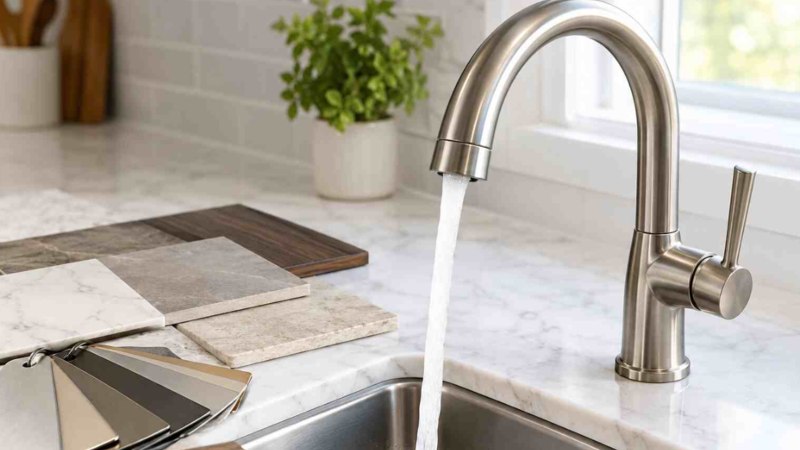
A faucet is the one piece of a kitchen or bathroom you touch every day, and the finish is what you see every time you do. The showroom version is flawless. The real question is what it looks like after five years of hard water, hand soap, cleaning sprays, rings, keys and a thousand wet hands. Some finishes are made for that. Some are made for the photograph.
This is how the common finishes actually hold up, what wears out underneath them, which cleaning habits ruin them, and how to choose so the faucet looks right for as long as the rest of the room.
How a finish is made, and why it matters more than the color
Almost every faucet starts as a brass or zinc body. The finish goes on top by one of three methods, and the method matters more than the color.
Electroplating deposits a thin layer of metal, usually chrome or nickel, onto the body. It is the oldest method, inexpensive, and for chrome in particular extremely hard-wearing. Its weakness is edges and threads, where the plating is thinnest.
Powder coating or paint sprays a colored coating onto the body and bakes it. This is how many inexpensive black, white and colored faucets are made. The coating chips at edges, wears where the handle is gripped, and can be lifted by harsh cleaners.
PVD, physical vapor deposition, bonds the finish to the metal at the molecular level inside a vacuum chamber. A PVD finish is several times harder than electroplating, resists scratches, chemicals and tarnish, and does not chip. Most reputable manufacturers now offer PVD on their nickel, brass, bronze and black finishes, and it is worth asking for by name. Two faucets that look identical on a shelf can differ by a decade of life depending on whether the finish is PVD.
Living finishes are the exception on purpose. Unlacquered brass, raw copper and some oil-rubbed bronzes are meant to change: they darken, develop a patina, and lighten at the edges where hands touch them. Beautiful if you want it, alarming if you expected the showroom color to stay.
The finishes, ranked by how they age in hard water
| Finish | Durability | Shows water spots | Shows fingerprints | Notes for a hard-water area |
| Polished chrome | Excellent | Badly | Yes | Hardest-wearing and cheapest; wipe daily or accept spots |
| Brushed or satin nickel | Excellent (PVD) or good (plated) | Lightly | Barely | The safest all-round choice for family bathrooms |
| Stainless look | Good to excellent | Lightly | Barely | Usually a finish over brass; pairs with stainless appliances |
| Matte black | Excellent if PVD, poor if painted | Very visibly | Barely | White mineral spots on a dark surface; daily wipe or a softener |
| Brushed brass / champagne bronze | Excellent (PVD) | Lightly | Barely | Warm, forgiving; confirm it is PVD, not lacquer over brass |
| Polished brass | Good (PVD) | Visibly | Yes | Shows every drop; high maintenance |
| Oil-rubbed bronze | Varies; often a living finish | Moderately | No | Lightens at edges by design on many products |
| Unlacquered brass | Living finish | Not an issue | Not an issue | Will tarnish within months; that is the point |
If the question is which finish needs the least attention in Houston water, the answer is brushed nickel in a PVD finish from a brand that stocks parts. If the question is which finish you love, buy that one and plan for the wiping.
What hard water does, inside and out
Houston water carries enough dissolved calcium and magnesium to leave a visible residue on anything it dries on. On the outside of a faucet that means spots and a dull film that builds into a crust around the base and the spout. On the inside it means scale building up on the aerator screen, inside the cartridge and in the spray head, which is why a faucet starts to drip, stiffen, or spray sideways after a few years. Pull-down kitchen faucets suffer most because the spray head has dozens of tiny outlets that clog one by one.
Two habits slow it down. Dry the faucet after use; a cloth hanging under the sink is enough. And unscrew the aerator every two or three months and soak it in white vinegar for an hour, then rinse. If the whole house suffers from scaled showerheads, spotted glassware and a rumbling water heater, a whole-house softener fixes the faucet problem and everything else at once.
Cleaning: what helps and what strips the finish
| Do | Avoid |
| Mild dish soap and warm water, then dry with a soft cloth | Abrasive pads, scouring powders, magic erasers on any finish |
| White vinegar diluted 1:1 for spots, rinsed off within minutes | Leaving vinegar or any acid sitting on brass or bronze finishes |
| Microfiber for daily wipe-downs | Bleach, ammonia and most bathroom sprays on PVD, brass and black finishes |
| Manufacturer’s own cleaner where one is specified | Drill brushes and steel wool on aerators and spray heads |
A surprising number of ruined finishes are not worn out; they are chemically stripped by a cleaning product used weekly for two years. Read the faucet’s care sheet once. If a product is not on it, keep it off the faucet.
What actually wears out
Finishes get the attention, but faucets fail from the inside. The cartridge, ceramic disc or rubber seat that controls the flow wears or scales up, and the result is a drip from the spout, water at the base, or a handle that will not turn smoothly. The O-rings around the spout fail and water appears on the deck. The aerator clogs and the stream splits.
Every one of those parts is replaceable in a faucet from an established brand, which is the whole point of buying an established brand: ten years on, a plumber can still get the cartridge. A dripping brushed-nickel faucet with an available cartridge is a short repair. A no-name matte black faucet with no parts supply is a replacement, however good it looked in year one. If a faucet in the house has started dripping or leaking at the base, faucet repair in Houston is usually a cartridge, seat or seal rather than a new fixture, and a repair keeps the finish you chose.
The parts nobody looks at
Under every faucet are two small shutoff valves, two supply lines, and the drain assembly. They are usually as old as the faucet they serve, and they decide whether a future leak is a towel job or a flooded cabinet.
Multi-turn shutoff valves seize after years of sitting still; on the day a supply line fails, the valve will not close and the only way to stop the water is the house main. When a faucet is being replaced anyway, have the valves replaced with quarter-turn ball valves and the supply lines with braided stainless, and the next problem under that sink becomes a small one. If the shutoff valve under the sink is stuck already, do not force it; a snapped stem on a live line turns a faucet swap into an emergency.
Matching finishes across a room, and across a house
Designers mix finishes deliberately now, but the mix has rules that keep a room from looking accidental.
- One finish for the water: faucet, shower trim, tub filler. These are seen together and should match exactly, from the same manufacturer where possible, because “brushed nickel” varies in warmth between brands.
- One finish for the hardware: cabinet pulls, towel bars, hooks. This can contrast with the water finish.
- Lighting can go either way, and black lighting over nickel plumbing is a common, safe pairing.
- Across the house, consistency matters less than most people think. Nobody compares the guest bath faucet to the kitchen. Within a single room, it is the first thing people notice.
Buying checklist
- Choose a brand that publishes a parts diagram and sells cartridges separately. If you cannot find the cartridge for sale today, you will not find it in ten years.
- Ask whether the finish is PVD. For black, brass and bronze, insist on it. For chrome, plating is fine.
- In hard water, prefer brushed or satin over polished, and know what matte black asks of you.
- Match the faucet’s hole configuration and spread to the sink: single hole, 4-inch centerset, or 8-inch widespread. A faucet that does not match the sink’s drilling is a deck plate or a new sink.
- Check spout height and reach against the basin. A tall arc over a shallow bathroom sink splashes; a low spout over a deep farmhouse sink is awkward.
- Buy the matching shutoff valves and supply lines at the same time if the existing ones are old. A plumber doing a sink and faucet installation will replace them in the same visit if the parts are there.
- For pull-down kitchen faucets, check that the spray head is metal rather than plastic and that the hose has a counterweight or docking magnet; those are the two parts that fail on cheaper models.
Three common questions
Is a more expensive faucet actually better? Up to a point. The jump from a bargain faucet to a mid-range one from an established brand buys a brass body, a PVD finish, a ceramic cartridge and a parts supply. Above that, you are paying for design and finish options, not more durability.
Can a faucet be refinished instead of replaced? Not well. Plating and PVD are factory processes. Painted “refinishing” wears quickly on a part that gets wet hundreds of times a day. Replace the faucet and keep the one you love for a dry room.
Why does only one faucet in the house have low pressure? Almost always the aerator or the cartridge is clogged with scale. Clean the aerator first; if that does not fix it, the cartridge is next. If every faucet is low, the cause is the pressure regulator or the main line, not the faucets.
The honest answer
Finish is a design decision; the parts supply underneath is what decides whether the faucet is fixed or thrown away. Royal Flush Affordable Plumbing, a Houston plumbing company that repairs and replaces faucets every week, sees the same pattern on every street: the homeowners who chose a known brand in a PVD finish are the ones whose ten-year-old faucets still look new after a cartridge and an aerator, and the ones who chose by photograph are shopping again.