
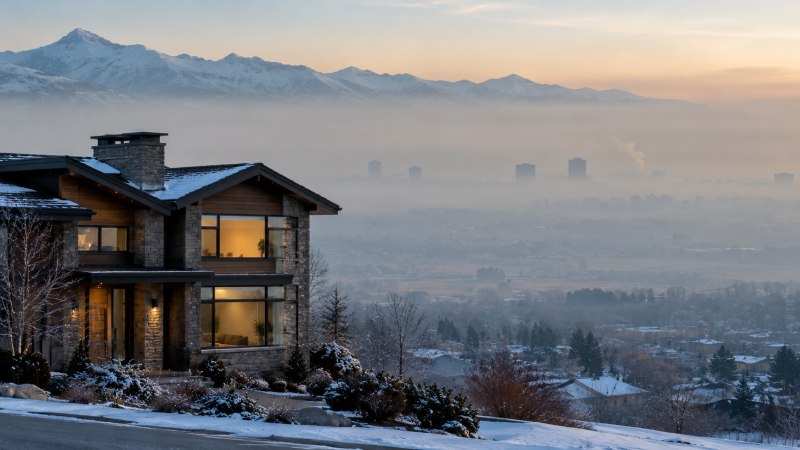
Every winter across mountain valleys, a familiar gray haze settles over the horizon. High-pressure weather systems trap cold air on valley floors beneath a warm atmospheric lid, creating persistent temperature inversions. Along with freezing fog, this atmospheric trap holds fine particulate matter (PM2.5), vehicle exhaust, and woodsmoke close to the ground.
Closing windows and staying indoors feels like a safe retreat, but that protection is often an illusion. An unsealed house constantly exchanges air with the outdoors through structural gaps, pulling toxic winter inversion air straight into living spaces. Here is how valley inversion air penetrates homes and how high-performance design stops it.
The Anatomy of a Winter Inversion: Why Valley Air Turns Toxic
The quick answer: Temperature inversions trap cold air and fine particulate matter (PM2.5) in mountain basins until a passing storm clears the atmosphere.
Under normal conditions, warm surface air rises, dispersing pollutants into the upper atmosphere. During an inversion, high-pressure ridges act like a lid over valley bowls. Cold, dense air settles along the valley floor, unable to rise through the warmer layer above.
Without storms to clear the basin, particulate pollution accumulates daily. PM2.5 combustion byproducts bypass respiratory defenses and lodge deep in lung tissue. When polluted air hovers outside for weeks, unsealed homes allow particulate matter to migrate indoors continuously.
The Stack Effect: How Your Heated Home Acts Like a Smog Vacuum
The quick answer: Warm air escapes through upper ceiling leaks, creating negative pressure that pulls cold, polluted outdoor air inside through lower-level cracks.
The primary driver pulling inversion air into living spaces is stack effect air infiltration. Because warm air is lighter than cold air, indoor air heated by your furnace naturally rises toward ceilings and attics.
As warm air escapes through unsealed attic hatches, recessed lighting, and top-plate framing gaps, it creates an indoor pressure imbalance. The lower level of your home develops negative pressure, functioning like a vacuum that pulls cold, dense outdoor air inward through foundation cracks, crawlspaces, rim joists, and electrical outlets.
Common Infiltration Zones Where Inversion Air Enters
The quick answer: Inversion air bypasses closed windows and doors, entering predominantly through hidden structural penetrations, uninsulated rim joists, and attic bypasses.
While homeowners often blame drafty windows, the most aggressive air infiltration occurs where building framing meets out of sight:
- Attic Bypasses: Gaps around plumbing vents, chimney flues, and dropped soffits vent warm indoor air directly into unconditioned attics.
- Rim Joists and Mud Sills: Framing on concrete foundations often lacks continuous air sealing, allowing outdoor air into basements.
- Recessed Ceiling Lights: Standard recessed cans act like tiny chimneys, leaking conditioned air upward.
- Exterior Wall Outlets: Electrical boxes cut into exterior drywall break the continuous air barrier, letting outdoor air enter wall cavities.
The Blower Door Test: Diagnosing Your Home’s Air Leakage
The quick answer: A blower door test depressurizes your home using a calibrated fan to quantify air leakage and locate hidden envelope breaches.
You cannot resolve air leakage without identifying where it occurs. A diagnostic blower door test mounts a specialized fan into an exterior doorway to depressurize the house to a standardized 50 pascals.
By measuring the airflow required to maintain this pressure, technicians calculate the home’s Air Changes per Hour at 50 Pascals (ACH50). While high-performance homes achieve an ACH50 of 1.5 or lower, older valley homes frequently score between 5.0 and 10.0 ACH50. Paired with infrared thermography, this test reveals exactly where cold inversion air infiltrates walls, framing joints, and ceilings.
Why Standard HVAC Systems Fail to Keep Particulates Out
The quick answer: Standard furnace blowers circulate air without creating positive indoor pressure, and basic fiberglass filters fail to capture sub-micron PM2.5 particles.
A common misconception is that running your furnace fan filters out inversion smog. Conventional HVAC systems recirculate existing indoor air rather than managing exterior pressure differentials. If the home has structural leaks, running the fan does not stop negative pressure from pulling outdoor air inward.
Furthermore, basic one-inch fiberglass filters protect equipment motors from large dust and lint, not human lungs from toxic particulates. Capturing PM2.5 requires filters rated at least MERV 13 or dedicated HEPA units. However, adding a restrictive filter to an older furnace cabinet can restrict airflow and strain blower motors if ductwork was not engineered for higher static pressure.
Architectural Solutions: Building an Airtight, Healthy Envelope
The quick answer: Permanent protection against inversion air requires a continuous exterior air barrier paired with balanced mechanical ventilation and high-efficiency filtration.
Stopping valley inversion air requires addressing the building envelope holistically. Designing a new custom home or retrofitting an existing structure demands an approach prioritizing continuous building envelope airtightness from foundation to roof ridge.
Rather than relying on basic caulking, comprehensive renovations integrate continuous exterior air barriers, advanced window flashing, and taped structural sheathing. To ensure an airtight home maintains exceptional indoor air quality, architects specify mechanical ventilation with heat recovery (an ERV or HRV system). An ERV continuously exhausts stale indoor air while introducing fresh outdoor air through dedicated MERV 13 or HEPA filters, capturing up to 85 percent of outgoing thermal energy.
When planning a major renovation or building a custom residence, consulting with experienced architectural design services in Salt Lake City, UT ensures your home incorporates passive building science, airtight assemblies, and advanced ventilation tailored to regional climate demands.
Immediate Action Checklist to Safeguard Indoor Air Quality
The quick answer: While planning long-term envelope improvements, take operational steps to reduce indoor particulate levels during active inversion episodes.
Before tackling architectural retrofits, homeowners can implement quick measures to protect indoor air during poor air quality warnings:
- Upgrade to MERV 13: If your HVAC blower handles the static pressure, install a MERV 13 filter and inspect it monthly during winter.
- Deploy Standalone HEPA Purifiers: Place true-HEPA air cleaners in primary bedrooms and central living spaces, running them continuously.
- Seal Basic Penetrations: Apply foam gaskets behind exterior wall outlet plates and weatherstrip drafty exterior doors.
- Avoid Indoor Combustion: Refrain from burning wood in fireplaces or lighting candles, which rapidly spike indoor PM2.5 levels.
A home should be a safe haven, particularly when winter weather traps heavy particulate pollution across valley floors. Relying on closed windows to keep toxic air outside ignores the physics of how unsealed homes breathe. By understanding the stack effect, identifying structural infiltration paths, and investing in an airtight, mechanically ventilated building envelope, homeowners can permanently protect their indoor environment. Transforming your home into a high-performance sanctuary ensures that no matter how gray the valley sky turns, the air your family breathes indoors remains pure, fresh, and healthy.