
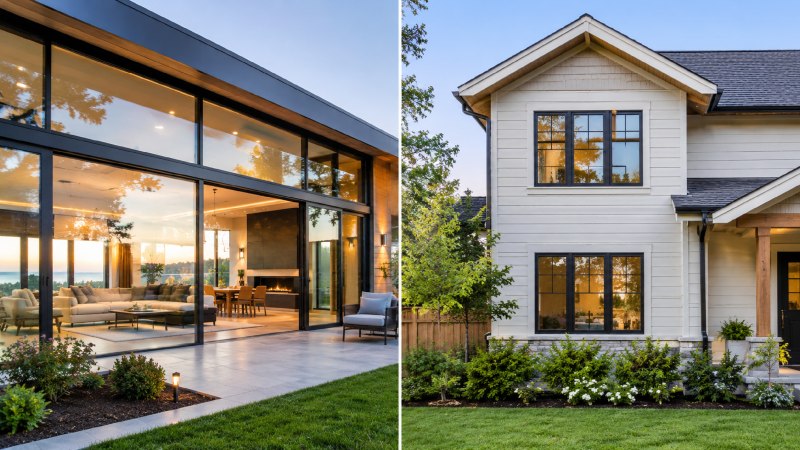
Choosing between expansive glass panels and traditional smaller windows is one of the most consequential decisions you will make during a home build or major renovation. The glazing you select changes your home’s exterior elevation, dictates interior furniture layouts, affects your monthly energy bills, and shapes how you interact with your surroundings every day.
While floor-to-ceiling glass walls dominate modern design magazines, they are not universally superior to traditional multi-window configurations. The right choice depends on your property’s orientation, architectural style, privacy requirements, and climate. Evaluating the distinct functional trade-offs of both options ensures you invest in glass that enhances your lifestyle rather than creating long-term headaches.
Visual Impact and Natural Light: Expansive Views vs. Focused Framing
The quick takeaway: Large glass panels dissolve the boundary between indoors and outdoors for panoramic views, while smaller windows create intimate light pockets and frame specific landscape features.
Oversized glass panels—such as multi-slide pocket doors, picture windows, and curtain walls—deliver an unmistakable sense of openness. They flood living areas with daylight, make compact floor plans feel significantly larger, and visually pull outdoor living spaces into the home. If your property borders a pristine lake, wooded ridge, or manicured backyard, large uninterrupted glass serves as living art.
Smaller windows, such as double-hung, casement, or awning styles, approach daylighting with restraint. Instead of completely exposing a room, they puncture the building envelope to capture morning sun or spotlight a particular garden vignette. Smaller windows also celebrate traditional architectural window styles, preserving the historic charm of Craftsman, Tudor, Colonial, and Farmhouse homes where massive modern sheets of glass would look out of place.
Energy Efficiency and Thermal Performance: Heat Loss vs. Solar Gain
The quick takeaway: Smaller windows provide superior overall wall insulation, whereas large glass panels require high-performance coatings to prevent high energy bills and uneven room temperatures.
Even the most technologically advanced triple-pane glass cannot match the insulating capability of a properly insulated solid wall. An insulated wall cavity typically delivers an R-value between R-13 and R-21, while a top-tier double-pane window hovers around R-3 to R-5. Consequently, replacing large expanses of wall area with glass inherently increases thermal exchange.
In cold climates, oversized panels risk radiant heat loss and cold drafts during winter nights. In hot, sunny regions, unshaded glass acts as a thermal amplifier, driving up air conditioning loads. If you lean toward large glass panels, pay close attention to the solar heat gain coefficient (SHGC) and U-factor ratings. Selecting low-emissivity (Low-E) spectrally selective glass, argon gas fills, and thermally broken aluminum or composite frames is non-negotiable to maintain consistent room temperatures.
Structural Demands and Wall Load Considerations
Quick takeaway: Large glass spans require substantial structural engineering, including heavy steel headers and point-load supports, which adds considerable cost before you even order the glass.
A common oversight during planning is assuming you can simply swap out three standard windows for a fourteen-foot glass slider. Standard windows fit between common wood framing studs with modest wooden headers distributing roof and floor loads.
Large glass openings disrupt this continuous load path. Installing a panoramic sliding glass wall often demands:
- Engineered structural steel beams (I-beams or flitch plates) to span the wide opening without sagging
- Reinforced corner posts and upgraded foundation footings to handle concentrated point loads
- Professional crane delivery and specialized suction-rig installation crews due to panel weights exceeding 300 to 500 pounds
Smaller windows distribute loads evenly across the exterior wall, requiring straightforward framing techniques that standard carpentry crews can complete quickly and affordably.
Privacy, Security, and Furniture Layout Flexibility
The quick takeaway: Smaller windows preserve interior wall space for storage and furniture while ensuring privacy, whereas large glass surfaces leave rooms exposed and complicate window coverings.
Every square foot of glass is a square foot of wall space you lose for art, entertainment centers, bookshelves, kitchen cabinetry, and sofas. In bedrooms and dense suburban settings, expansive glass can leave occupants feeling exposed to neighbors and street traffic.
Window coverings present another logistical hurdle. Finding functional custom window treatments for a sixteen-foot-wide by ten-foot-tall glass expanse is complex and expensive. Motorized drop-down shades, automated drapery tracks, or smart privacy glass often add thousands of dollars to your overall project budget. Smaller, standard-sized windows offer simple, off-the-shelf covering options—from plantation shutters to classic Roman shades—giving you precise control over light and privacy at a fraction of the cost.
Climate Resilience: Wind-Borne Debris and Storm Codes
The quick takeaway: Coastal regions and severe weather corridors demand engineered impact resistance, making structural integrity a top priority for wide glass spans.
Your geographical location plays an enormous role in determining whether large glass systems are practical. High-wind zones, hurricane corridors, and regions prone to severe convective storms enforce stringent building codes governing wind pressures and missile impact ratings.
Large sliding glass walls in storm-prone regions must withstand hundreds of pounds of cyclical wind pressure without deflecting or leaking. Homeowners upgrading coastal properties frequently install heavy-duty impact doors in Boca Raton, FL to meet demanding coastal wind-load requirements while preserving broad, unobstructed views of their patio and pool areas. In hurricane-prone environments, laminated impact glass ensures that even if flying debris shatters the outer layer, the tough polyvinyl interlayer remains intact, preventing sudden pressure changes that can lift roof structures.
Upfront Investment and Long-Term Maintenance Costs
The quick takeaway: Standard windows are economical to purchase, install, and maintain, while panoramic glass panels carry premium price tags and higher ongoing maintenance demands.
Cost is often the ultimate deciding factor. Standard production windows benefit from massive manufacturing scale, keeping unit costs low and replacement parts readily accessible. If a seal fails or a mower flings a rock into a standard double-hung sash, repair or replacement is fast and affordable.
Large architectural glass panels are custom-engineered products. Between specialized thermal breaks, commercial-grade rollers, tempered-laminated glass, and specialized shipping, panoramic systems can cost five to ten times more than an equivalent area covered by traditional windows. Maintenance is also more demanding; massive panes show water spots, fingerprints, and dust quickly, requiring frequent cleaning inside and out.
Room-by-Room Decision Guide: Matching Glass to Lifestyle
The quick takeaway: The most comfortable homes rarely use one window style exclusively; they pair expansive glass in shared living areas with practical, smaller windows in private retreats.
You do not have to choose a single window strategy for your entire house. The most successful residential designs balance both approaches depending on room function:
- Great Rooms and Kitchens: Ideal candidates for large sliding glass doors or floor-to-ceiling picture panels that showcase views and connect indoor cooking spaces with outdoor dining areas.
- Bedrooms and Bathrooms: Better suited for smaller, high-placed clerestory windows, awning units, or traditional double-hung windows that maintain privacy and leave ample space for dressers and headboards.
- Home Offices: Benefit from paired casement windows that offer natural daylight and cross-ventilation without producing overwhelming glare on computer monitors.
Finding the Right Fit for Your Space
Selecting between expansive glass panels and smaller windows is not an all-or-nothing choice. Oversized glass delivers unparalleled drama, deep natural illumination, and seamless indoor-outdoor living, making it well worth the structural and financial investment for prime gathering zones. Conversely, smaller windows provide essential wall space, thermal efficiency, straightforward privacy, and structural simplicity for everyday comfort. By assessing your home’s architectural integrity, environmental exposure, and daily living patterns room by room, you can create a balanced design that feels open, protected, and functional.